
Watch first, identify second
Stop in a safe place on an established path, let your eyes settle and look for movement at different heights. Note the bird’s size, outline, colours and behaviour before reaching for a name. Binoculars let you look from a distance; a phone photograph can support a later identification without needing to approach.
These three species are an introduction, not a complete checklist for the park. A green parakeet is not automatically an echo, and a pigeon near a picnic area is not automatically a pink pigeon. If the view is incomplete, leave the identification open.
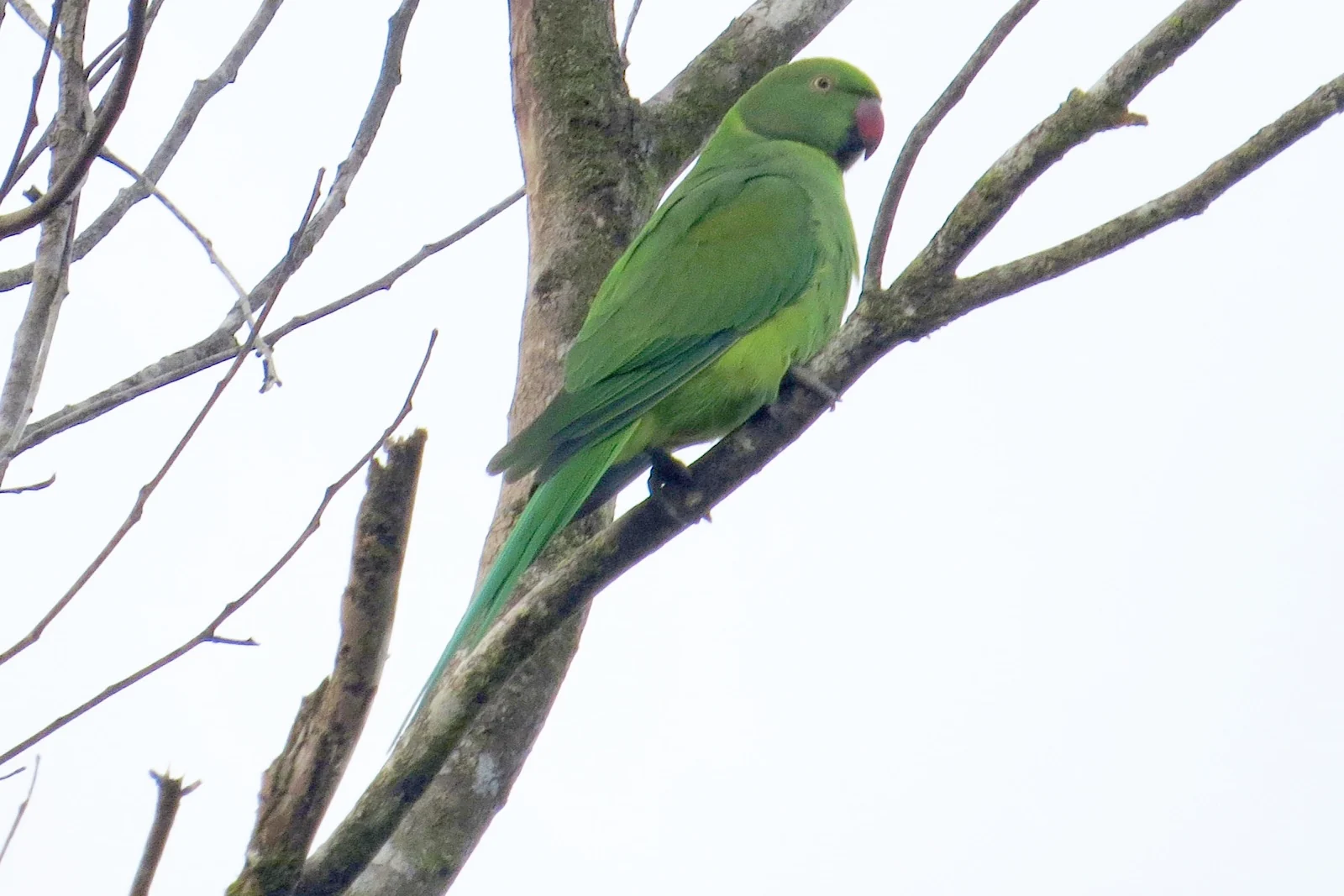
Echo parakeet
The echo parakeet, Psittacula eques, has green plumage and a long tail. Adult males have a red upper bill; adult females have a dark bill. The World Parrot Trust describes this difference alongside the male’s head and neck markings. Young birds complicate the picture, so bill colour alone should not decide every identification.
The introduced rose-ringed parakeet can cause confusion. Compare the whole bird rather than treating any green bird overhead as an echo parakeet. The echo parakeet is also known by the scientific name Alexandrinus eques.
Pink pigeon
The pink pigeon, Nesoenas mayeri, is softer in colour than its name can suggest. Look for pale pink tones, contrasting brown wings and reddish bare parts rather than bright, uniform pink. It is a forest pigeon, and a clear view of the whole bird is more helpful than a fleeting glimpse of one coloured patch.
Pink pigeon populations in Black River Gorges benefit from continuing conservation work by the Mauritian Wildlife Foundation. A bird near people is still a wild animal. Do not offer bread, snacks or leftovers; conservation feeding is managed by the conservation team.
Mauritius kestrel
The Mauritius kestrel, Falco punctatus, is a small falcon with a chestnut-brown head and pale underparts marked with dark spots. Its hooked bill and raptor shape distinguish it from the parrots and pigeons of the forest.
If you notice a perched bird of prey, observe without moving beneath it or trying to make it fly for a photograph. Distance, light and a brief view can hide key details. A tentative note and a photograph taken from the path are better than a confident but unsupported species claim.
Make the encounter good for the bird
Keep voices low, give other walkers room and avoid playing recorded calls to bring birds closer. Leave nests, nest boxes and conservation equipment undisturbed. Do not enter a restricted area because a rare bird has been reported there; an observation record is not permission to visit.
Take every scrap of litter away. In a 2024 report, MWF described rescuing a pink pigeon injured by discarded nylon and explained how visitor food complicated its capture. Small visitor choices have real consequences. Share useful observations with the Centre, but avoid publishing precise nest locations.
Turn a brief sighting into a useful observation
Notice size, shape, movement and sound before trying to name the bird. Record where you were, the time and whether it was feeding, perched or flying. A modest photograph from the path can help you compare features later without following the animal.
Binoculars are more useful than trying to walk closer. Give another visitor room to see without crowding the perch, and lower your voices while watching. Keep precise nest locations private. For a first visit, learning to separate a parakeet, pigeon and small falcon is already a useful start.
Current access
Access not confirmedWe are awaiting a current report from the National Park Information Centre. Confirm access at your entrance before setting out.
Read park and trail access information →Your questions answered
Will I definitely see these birds?
No. Wildlife encounters depend on many factors, and a chosen trail cannot guarantee a species. Plan a forest visit you will enjoy regardless of sightings.
Are all green parakeets echo parakeets?
No. Introduced rose-ringed parakeets can look similar. Use several features, a good view and a reliable identification reference.
Can I feed a pink pigeon if it approaches me?
No. Keep your food to yourself. Specialist conservation feeding follows managed protocols and is different from giving visitor food to wild birds.
Sources behind this guide
References used for this guide. Current access is shown separately with its own report date.
- NPCS fauna unit species descriptions ↗
- NPCS Mauritius kestrel description ↗
- World Parrot Trust echo parakeet profile ↗
- Mauritian Wildlife Foundation pink pigeon field team, 27 September 2023 ↗
- Mauritian Wildlife Foundation litter injury and visitor feeding report, 13 September 2024 ↗
- Paignton Zoo pink pigeon species and conservation profile ↗